
Best High Index Lenses for Strong Prescriptions (2026)
Got a prescription that's pushing past ±4 diopters? You don't have to sacrifice style or comfort, high‑index lenses can keep your glasses sleek, light, and crystal‑clear. Let's break down how the right index, frame shape, and a few smart tweaks can turn those ‘thick‑as‑brick’ lenses into a look you'll actually love.
In this guide, you'll learn about the best high index lenses for strong prescriptions, from the affordable 1.67 to the ultra-thin 1.90 glass. We'll cover thickness, weight, cost, and how to choose the right one for your needs. Plus, we've included expert tips on frame selection and coatings so you can make an informed decision. Let's jump in.
1. 1.67 High-Index Lenses , Best Balance of Thickness and Cost
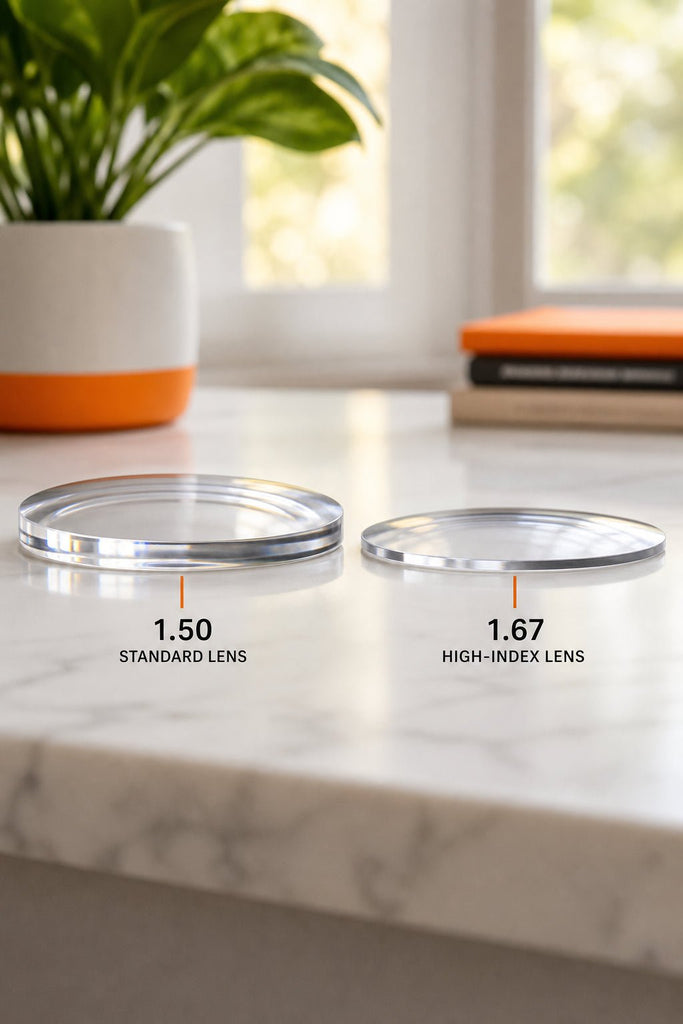
If your prescription falls between -4.00 and -8.00 diopters (or +3.00 to +6.00 for farsightedness), the 1.67 high-index lens is the workhorse you want. It offers a significant reduction in thickness compared to standard 1.50 plastic, around 20, 30% thinner, without breaking the bank. Most online retailers, including Lensmart's guide on 1.67 vs 1.74, highlight it as the top choice for moderate prescriptions. At roughly £49, $74, it's a sweet spot that delivers thinner edges and lighter weight without the premium price of higher indexes. Pair it with a full-rim frame to hide any remaining edge thickness, and you've got a comfortable, good-looking pair of glasses.
One thing to note: the 1.67 material has a moderate Abbe value (around 32, 33), which means optical clarity is good but not perfect. You might notice slight chromatic aberration (color fringing) around high-contrast objects. That's why an anti-reflective coating is strongly recommended. The coating cuts reflections and sharpens vision, making the lenses perform even better. Also, because the lenses are lighter, they reduce pressure on your nose and ears, a big plus if you wear glasses all day.
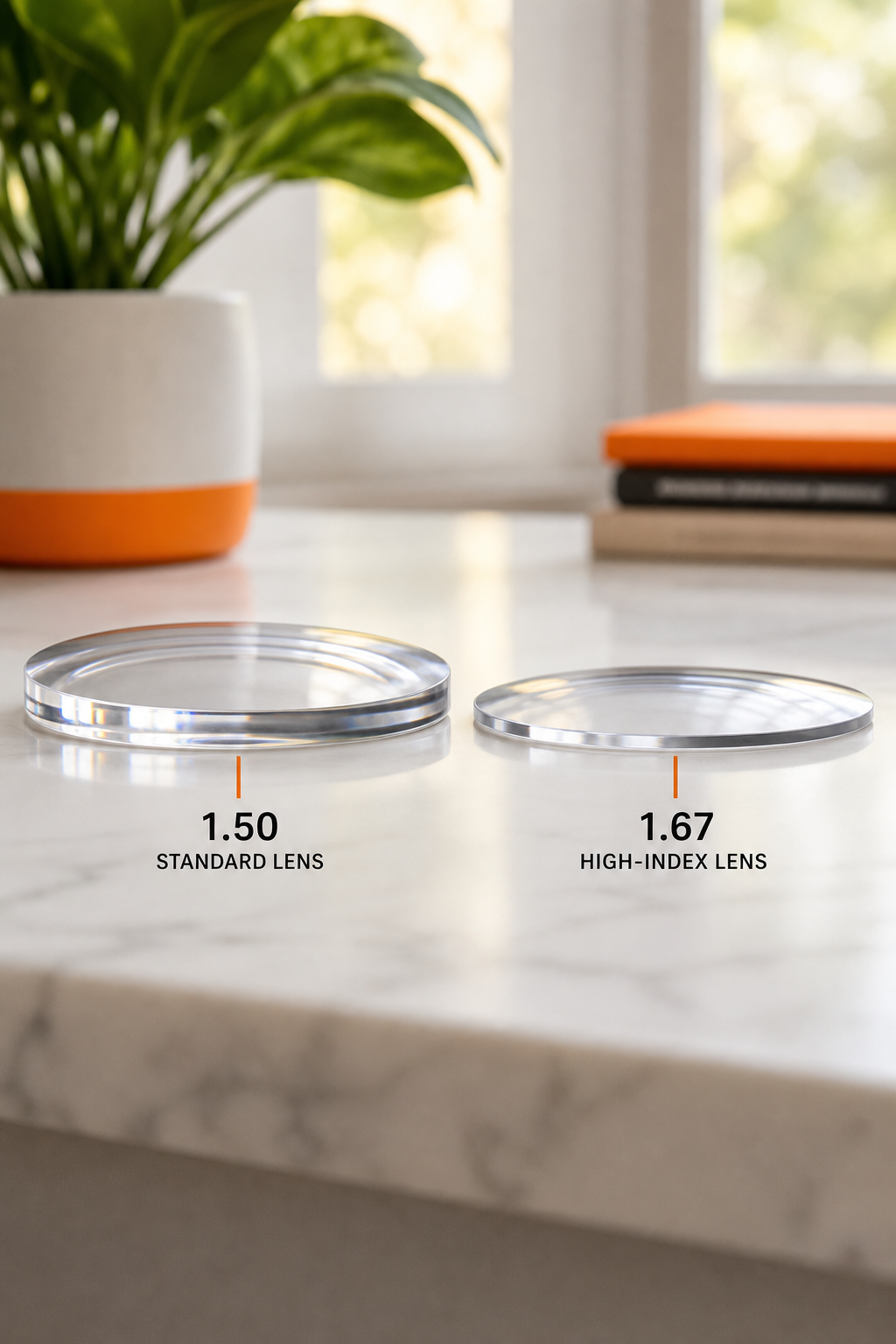
Pro Tip: Always choose a frame with a smaller eye size (40, 50 mm) to minimize thickness further. The lens gets thicker as you move away from the optical center, so a smaller frame keeps the edge thin.
For astigmatism, the 1.67 works well up to about -2.00 diopters of cylinder. Beyond that, you may want to step up to a higher index to keep the lens thin and avoid visible warping. But for most people with strong prescriptions, 1.67 is the go-to. It's available in many colors and transitions options, giving you flexibility in style. If your prescription is under -8.00, this is likely your best bet.
2. 1.74 High-Index Lenses , The Most Popular Choice for Strong Prescriptions
When your prescription climbs above -8.00 or +4.00 diopters, the 1.74 high-index lens becomes the standard recommendation. It's the thinnest plastic lens widely available, offering about 8, 15% more thickness reduction compared to 1.67. That extra thinness can make the difference between lenses that protrude from a rimless frame and ones that sit flush. According to Wikipedia's article on corrective lenses, higher refractive indexes allow for flatter lens curves and less material, which is exactly what you need for strong prescriptions. The cost is higher, typically $100, 200 more than 1.67, but for many, the cosmetic and comfort benefits are worth it.

One trade-off is the Abbe value: 1.74 lenses have a lower Abbe (around 32) than 1.67, meaning more potential for color fringing. But modern aspheric designs minimize this effect. An anti-reflective coating is non-negotiable with 1.74 because the material reflects more light due to its higher index. The coating boosts light transmission to 99.5% and reduces glare, especially important for night driving. Also, 1.74 lenses are lighter than standard lenses, which improves comfort for all-day wear.
Frame choice matters even more with 1.74. Because the lens is thin, it can be paired with rimless or semi-rimless frames, something impossible with lower indexes. If you've always wanted sleek, wire-rim glasses but thought your prescription ruled them out, 1.74 makes it possible. Just ensure the frame's eye size is under 50 mm and the shape is round or squarish to avoid excessive edge thickness. With these lenses, you get both style and function.
Key Takeaway: 1.74 is the top choice for very strong prescriptions (above -8.00 D). It pairs well with thin frames and offers maximum aesthetic payoff.
Some opticians advise stepping up to 1.74 only if you care deeply about cosmetics. If budget is tight, 1.67 with a thick acetate frame still works well. But for rimless or metal frames, 1.74 is often the only option that looks good. The research shows that 1.74 lenses are consistently priced higher, but the gap has narrowed in recent years as manufacturing improves. Check online retailers for deals, some offer bundled coatings that bring down the effective cost.
3. 1.76 High-Index Lenses , Super-Thin for Extreme Prescriptions
If you thought 1.74 was thin, wait until you see 1.76. This index is less common but available from select manufacturers, especially in Europe and Asia. It's a plastic lens that pushes the limits of polymer technology, offering about a 45% thickness reduction compared to standard plastic. That's even thinner than 1.74, roughly an additional 5, 10% reduction. For prescriptions beyond -10.00 or +6.00 diopters, 1.76 can be a major change, especially if you want to use a delicate frame.
The catch? Availability is limited. Not all labs stock 1.76, and you may need to order from a specialty provider. The cost is also higher, often double the price of 1.67. Because the Abbe value is lower, chromatic aberration can be more noticeable, so an anti-reflective coating is essential. Some users report a slight "warm" tint to the lens due to the material's light transmission properties, but this is usually minor. If you prioritize extreme thinness and have the budget, 1.76 is worth exploring.
When choosing frames for 1.76, stick to small, round shapes to maximize the thinness. Avoid very large frames (over 50 mm) because even with 1.76, the edge thickness can become visible if the frame is too wide. Also, consider an aspheric design (more on that in section 5) to flatten the front curve and reduce the lens bulge. Many high-end lens brands like Zeiss and Hoya offer 1.76 options, but they come at a premium. Ask your optician for a quote and check if your insurance covers high-index upgrades.
Pro Tip: If you're considering 1.76, ask for a demo lens to see the actual thickness. Because the index is rare, online retailers may not have it in stock, so verify lead times.
For extreme prescriptions (above -12.00), 1.76 may still leave some edge thickness, but it's far better than any lower index. It also helps with weight, these lenses are very light, reducing pressure on the bridge. If you've struggled with heavy glasses causing red marks, 1.76 combined with a lightweight frame can be a relief. Just be prepared for the premium price and limited color options (fewer photochromic choices).
4. 1.90 High-Index Glass Lenses , Maximum Thinness for Very High Rx
For the absolute thinnest and most optically precise lenses, 1.90 glass is the champion. Glass can achieve a refractive index of 1.90, which plastic cannot reach (plastic maxes out at 1.76). This means 1.90 lenses are about 15, 20% thinner than even 1.76 plastic. According to the FTC's Eyeglass Rule, your prescription belongs to you, and you can take it to any provider, including those offering 1.90 glass. But there's a price shock: a pair of 1.90 lenses can cost $350 or more, according to VS Eyewear's listing. That's over ten times the cost of a basic 1.60 lens.
Who needs 1.90? If your prescription exceeds -10.00 or +8.00 diopters and you want the sleekest possible look, glass does it. The Abbe value is much higher (around 50+), meaning virtually no chromatic aberration, colors stay sharp and clear. Glass is also more scratch-resistant than plastic. However, glass is heavier and more fragile. It can shatter on impact, so it's not recommended for children or active lifestyles. With 1.90 glass, frame choice is critical: you must use a small, round frame (under 45 mm) to keep weight manageable and avoid the lens becoming too thick at the edges. Some high-end frame brands like Lindberg offer buffalo horn or titanium frames that pair beautifully with glass. The combination of ultra-thin glass and premium frame can be stunning, but it's not cheap.
One more thing: 1.90 glass requires a hydrophobic anti-reflective coating to reduce glare and repel water. Many providers include this in the price. The lenses also offer natural UV protection. If you're noticing the "coke-bottle" effect with your current glasses, 1.90 glass eliminates it almost entirely, your eyes will appear normal size, not magnified or minified. For those who prioritize optical clarity and thinness above all else, this is the pinnacle.
Key Takeaway: 1.90 glass offers the thinnest lenses for extreme prescriptions (above -10.00 D). It's heavy and expensive but optically superior.
But remember: if your prescription is below -8.00, 1.90 is overkill, it won't be noticeably thinner than 1.76 for moderate powers. Use the research: the price jump at 1.90 is dramatic, so only invest if your prescription truly benefits. Also, glass is not ideal for rimless frames because of fragility. Stick to full-rim metal or acetate frames for safety.
5. Aspheric High-Index Lenses , Reduced Distortion and Slimmer Profile
Aspheric design is not a separate index but a lens shape that works with high-index materials to further reduce thickness and distortion. Traditional spherical lenses bulge outward, making the eyes look larger (for minus prescriptions) or creating magnification effects. Aspheric lenses have a flatter front curve, which not only reduces the "bug-eye" look but also minimizes peripheral distortion. According to Barnes Talero EyeCare's page on aspheric lenses, this combination is ideal for strong prescriptions because it flattens the lens profile and makes the glasses look more natural on your face.
When you pair aspheric design with a 1.67 or 1.74 index, you get the best of both worlds: ultra-thin lenses that appear almost flat from the front. This is especially beneficial for farsighted prescriptions, where the center of the lens is thick. Aspheric design flattens the center bulge, reducing the eye magnification effect. For nearsightedness, the edge thickness is reduced even more. Many high-index lenses already come with an aspheric option at no extra cost, but some manufacturers charge a small fee. Always ask for aspheric if you have a strong prescription, it's worth the upgrade.
Aspheric lenses also improve field of vision. The flatter design means less distortion when you look to the side, which is great for driving and sports. However, aspheric lenses can be more sensitive to fitting: if the frame doesn't align with your pupil distance, you may experience blurry peripheral vision. Ensure your optician measures your PD accurately. For rimless frames, aspheric design helps hide the lens thickness because the edge is thinner and more uniform. If you're considering a rimless or semi-rimless frame, ask for both high-index and aspheric to maximize cosmetic results.
Pro Tip: Aspheric high-index lenses work best with round or oval frames because the lens geometry matches the curve. Avoid very square frames that can cause distortion at the corners.
One downside: aspheric lenses can sometimes produce "swirling" effects in your peripheral vision if the lens is made with a low Abbe material. That's why combining aspheric with a good anti-reflective coating is important. Also, aspheric lenses may be more expensive than standard spherical ones, but the cost is usually modest ($20, $50). For strong prescriptions, the reduction in weight and distortion is dramatic. I've seen many patients switch to aspheric high-index and immediately notice less eye strain and better clarity. It's a small investment that pays off in comfort.
Buyer's Guide: What to Look for in High Index Lenses
Choosing the right high-index lens isn't just about picking a number. Here's a checklist to help you decide:
- Prescription strength: For -4.00 to -8.00, 1.67 is enough. Above -8.00, consider 1.74 or 1.76. Extreme prescriptions (above -10.00) may benefit from 1.90 glass.
- Frame style: Full-rim frames hide edge thickness best. Rimless and metal frames need the highest index for a thin profile. Small, round frames reduce thickness and weight.
- Coatings: Anti-reflective, UV400, and scratch-resistant are standard. Always add AR for high-index lenses to reduce chromatic aberration and glare.
- Aspheric design: Strongly recommended for all high prescriptions, it flattens the lens and reduces distortion.
- Weight: Lighter lenses reduce nose pressure. Glass is heavier than plastic, so if weight is a concern, stick with plastic.
- Budget: 1.67 is cost-effective. 1.74 and 1.76 are pricier. 1.90 glass is the most expensive.
- Optical clarity: Lower Abbe values (under 35) can cause color fringing. High-index glass has better Abbe values.
When ordering online, ensure the retailer provides precise measurements like pupillary distance and segment height. The Óculos de Grau collection at Ótica FagLux offers a variety of frames that work well with high-index lenses, demonstrating the importance of frame selection. Also, check the lens thickness guarantee, some retailers will remake lenses if the thickness exceeds expectations. For astigmatism, consider free-form digital surfacing for custom optimization. And always keep your prescription handy; you have the right to obtain it under the FTC's Eyeglass Rule.
20-30%thickness reduction from 1.67 vs standard 1.50 lenses, based on industry data.
Your final choice should balance prescription, frame, budget, and priorities. If you're unsure, consult an optician, they can show you lens thickness simulators. Remember, the goal is clear, comfortable vision without the thick-lens look. With the right high-index lenses, you can have that.
Frequently Asked Questions
Are high-index lenses worth the extra cost for strong prescriptions?
Yes, if you value thinner, lighter glasses and better appearance. High-index lenses reduce the "coke-bottle" effect and make glasses more comfortable. For prescriptions over ±4.00, the cost is justified. For lower prescriptions, standard lenses are fine.
What is the difference between 1.67 and 1.74 high-index lenses?
1.74 is thinner and lighter than 1.67, offering about 8, 15% more thickness reduction. 1.74 is also more expensive and has a slightly lower Abbe value (more chromatic aberration). Use 1.67 for moderate prescriptions and 1.74 for very strong ones (above -8.00).
Do high-index lenses cause distortion?
They can cause some chromatic aberration (color fringing) due to lower Abbe values, especially at 1.74 and higher. Aspheric designs minimize distortion, and an anti-reflective coating helps. Proper fitting also reduces peripheral issues.
Can I use high-index lenses with rimless frames?
Yes, especially with 1.74 or 1.76 plastic lenses. Rimless frames need thin, durable lenses. High-index glass (1.90) is too fragile for rimless. Ensure the lens edges are polished to prevent chipping.
How do I care for high-index lenses?
Clean with a microfiber cloth and lens cleaner. Avoid abrasive materials. High-index plastic is softer than standard plastic, so scratches are more common. Use a scratch-resistant coating and store in a hard case. For glass, handle with care to avoid breakage.
What coatings are essential for high-index lenses?
Anti-reflective (AR) coating is essential, it reduces reflections and improves clarity. UV400 protection is built into most high-index materials. Scratch-resistant coating is highly recommended. Hydrophobic coatings are optional but help repel water and smudges. Always add AR to reduce chromatic aberration.
Can I get transitions or photochromic coatings on high-index lenses?
Yes, but availability varies. 1.67 and 1.74 offer several transition options. 1.76 and 1.90 glass have limited choices. Check with your retailer for the specific index and coatings you need. Some high-index materials have slow fading times, so research before buying.
How do I measure my pupillary distance for high-index lenses?
PD must be accurate to avoid induced prism and eye strain. Use a ruler and mirror, or ask your optician. Many online retailers provide guides. For high prescriptions, a PD error of even 2 mm can cause discomfort. Consider professional measurement.
Conclusion
Choosing the best high index lenses for strong prescriptions comes down to balancing your prescription strength, frame choice, and budget. The 1.67 lenses offer the best value for moderate prescriptions, while 1.74 is the go-to for very strong ones. If you need extreme thinning, 1.76 plastic or 1.90 glass are options but come with higher costs and trade-offs. Aspheric designs enhance thinness and reduce distortion, making them a smart addition for any high prescription.
Remember to always order anti-reflective coatings, choose a small round frame, and get precise measurements. Whether you opt for the workhorse 1.67 or the premium 1.74, the right high-index lens can transform your eyewear experience. Start by getting your prescription from your eye doctor, then explore online retailers that offer competitive pricing and customization. Your eyes deserve the best, and with high-index lenses, you can see clearly and look great doing it.

